Summary Plan Description Table of Contents
- Introduction
- Plan A - Schedule of Benefits
- Plan B - Schedule of Benefits
- Plan C - Schedule of Benefits
- Plan 11 - Schedule of Benefits
- Plan 11-C - Schedule of Benefits
- Plan 14 - Schedule of Benefits
- Eligibility for Active Participants
- Eligibility for Retiree Coverage
- Insurance Coverage
- Medical Benefits
- Prescription Drug Program
- Weekly Time Loss
- Medicare Part D Prescription Drug Plan (PDP) for Retirees
- Member Assistance Program (MAP)
- Dental Benefit
- Vision Benefit
- Hearing Benefit
- Special Fund Program
- Union Wellness Centers
- General Plan Exclusions and Limitations
- Other Limitations on Your Benefits
- Definitions
- Claim and Appeal Procedures
- General Plan Provisions
- Information About the Plan
- Board of Trustees
General Plan Provisions
LEGAL PROCEEDINGS
No action at law or in equity or otherwise may be brought on any claim or other matter whatsoever against the Fund, the Trustees, or their designated agents unless all of the claim filing and claim appeal procedures of the Plan have been followed and exhausted. Any action at law or in equity to recover under this Plan or in any affecting this Plan must be brought in the United States District Court for the Northern District of Illinois, Eastern Division, within three years from the time written proof of loss is required to be furnished and within one year of either the date of final decision under the Plan's appeal procedures, the date a final decision was required under the appeals procedures if no final decision was made or the date of final Trustee action in a matter not involving a claims appeal.
These terms do not extend or reinstate any claim or cause of action which has expired under the time limits set forth in the Trust Agreement, or in any Plan document or regulations of the Trustees or under any statute if such time limit has previously expired. These provisions do not apply to any matter covered or purportedly covered by the terms of any insurance policy procured by the Trustees.
PRIVACY OF AN INDIVIDUAL'S HEALTH INFORMATION
The IBEW Local 701 Welfare Fund will use and disclose protected health information (individually identifiable health information, regardless of the form in which it is kept) only to the extent of and in accordance with the uses and disclosures permitted or required by the Health Insurance Portability and Accountability Act of 1996 (HIPAA) and Department of Health and Human Service Regulations Regarding Privacy of Individually Identifiable Health Information. The Fund will not disclose protected health information to the Plan Sponsor, the Board of Trustees of the IBEW Local 701 Welfare Fund, or permit a health insurance issuer or HMO to disclose protected health information, unless this disclosure complies with the Health Insurance Portability and Accountability Act of 1996 (HIPAA) and Department of Health and Human Service Regulations Regarding Privacy of Individually Identifiable Health Information. The Fund further complies with HIPAA by providing to individuals covered by the Plan, in accordance with HIPAA and its Regulations, a Notice of Privacy Practices detailing the Fund's practices regarding protected health information.
PAYMENT OF BENEFITS AND NON-ASSIGNMENT OF CLAIMS
Medical benefits provided by this Plan for PPO services are always paid directly to the provider. Benefits for non-PPO services will also be paid directly to the provider unless you can provide proof that you already paid the bill.
NVA, the Plan's vision network and claims administrator, pays in-network providers directly. Out-of-network claims will be paid to you.
In-network dental claim payments will be made to the dentist. Out-of-network dental claims will be paid to you unless you have made arrangements for payment to the provider.
Weekly Loss of Time Benefits will be paid to you every two weeks during any period for which benefits are payable. Any balance remaining unpaid at the termination of such period will be paid immediately upon receipt of due proof.
Life Insurance benefits will be paid to your designated beneficiary. If your designated beneficiary does not survive you, death benefits will be paid to the person(s) specified in your life insurance policies or to your estate.
Except to the extent set forth above, all benefits shall be paid to the Eligible Participant or Eligible Retiree who incurs the charges or whose Eligible Dependent incurs the charges.
No Eligible Individual entitled to any benefits under this Plan shall have the right to assign, alienate, transfer, encumber, pledge, mortgage, hypothecate, anticipate, or impair in any manner his or her legal or beneficial interest, or any interest in assets of the Fund or benefits of the Fund. Neither the Fund nor any of the assets thereof shall be liable for the debts of any Eligible Individual entitled to any benefits under this Plan, nor be subject to attachment or execution or process in any court action or proceeding. You may not assign your benefit claim to a third party for payment or collection.
No assignment of any present or future right, interest, or benefit under the Plan shall bind the Trustees or the Plan without the Trustees' written consent. The Trustees may, at their option, accept a validly executed assignment of benefits made by the Eligible Participant, Eligible Retiree, or the spouse of an Eligible Participant or Eligible Retiree when such assignments are executed in favor of a provider delivering medical services or supplies that are covered by this Plan, in which case benefits shall be paid to the assignee instead of to the Participant. No assignment of benefits shall assign more than the assignor's right to payment of benefits and shall not be deemed to assign any other right or interest that the assignor has under the Plan, including, but not limited to, the right to appeal or seek review of a benefit denial. Under no circumstances shall an assignment of benefits provide an assignee or provider of services with the status of a Participant or Beneficiary under the Plan or under federal law. All actions to recover benefits or concerning payment for any services provided to a Participant or Beneficiary must be brought in the name of the Participant or Beneficiary and may not be brought by an assignee or provider of services.
TRUSTEE INTERPRETATION AND AUTHORITY; DECISIONS REGARDING BENEFITS
The Trustees or persons acting for them, such as a claims appeal committee, have sole authority to make final determinations regarding any application for benefits and the interpretation of the Plan of Benefits, the Trust Agreement and any other regulations, procedures or administrative rules adopted by the Trustees. Decisions of the Trustees (or, where appropriate, decisions of those acting for the Trustees) in such matters are final and binding on all persons dealing with the Plan or claiming a benefit
from the Plan. If a decision of the Trustees or those acting for the Trustees is challenged in court, it is the intention of the parties to the Trust that such decision is to be upheld unless it is determined to be arbitrary or capricious.
All benefits under the Plan are subject to the Trustees' authority to change them. The Trustees have the authority to increase, decrease, change, amend, or terminate benefits, eligibility rules, or other provisions of the Plan of Benefits as they may determine to be in the best interests of the Plan participants and beneficiaries.
Benefits under this Plan will be paid only when the Board of Trustees or persons delegated by them decide, in their sole discretion, that the participant or beneficiary is entitled to benefits.
The Plan is maintained for the exclusive benefit of the Plan's participants and their dependents. All rights and benefits granted to a participant under the Plan are legally enforceable.
The right to change or eliminate any and all aspects of benefits provided for retirees is a right specifically reserved to the Trustees, since retiree coverage is not an "accrued" or "vested" benefit. The Trustees have the authority to amend or terminate such benefits and to increase self-payments for the coverage at any time. Any such change shall be effective even though a Participant has already become an eligible retiree.
PLAN DISCONTINUATION OR TERMINATION
This Plan of Benefits may be discontinued or terminated under certain circumstances, for example if future collective bargaining agreements and participation agreements don't require employer contributions to the Fund. In such event, benefits for covered charges incurred before the termination date will be paid on behalf of eligible family members as long as the Plan's assets are more than the Plan's liabilities. Full benefits may not be paid if the Plan's liabilities are more than its assets, and benefit payments will be limited to the funds available in the trust fund for such purposes. The Trustees will not be liable for the adequacy or inadequacy of such funds.
LENGTH OF MATERNITY CONFINEMENTS
A federal law requires that a person who is eligible for maternity benefits and her newborn infant are entitled to at least 48 hours of inpatient hospital care following a normal delivery and at least 96 hours of inpatient hospital care following a Caesarian section. Further, a Plan cannot require the provider (hospital or physician) to obtain authorization from the Plan for prescribing a length of stay not in excess of these periods. (The attending provider may, however, after consulting with the mother, discharge the mother and newborn earlier than 48 hours following a vaginal delivery or 96 hours following a Caesarian section.)
The Plan will provide benefits for the covered charges incurred by an individual eligible for maternity benefits during the prescribed time periods (48 hours or 96 hours), subject to all applicable Plan
eligibility and benefit payment provisions and limitations as set forth in this Summary Plan Description booklet.
YOUR RIGHTS UNDER ERISA
Nothing in this statement is meant to interpret or extend or change in any way the provisions expressed in the Plan or insurance policies. The Trustees reserve the right to amend, modify or discontinue all or part of this Plan whenever, in their judgment, conditions so warrant.
As a participant in the IBEW Local 701 Welfare Plan, you are entitled to certain rights and protections under the Employee Retirement Income Security Act of 1974 (ERISA). ERISA provides that all Plan participants shall be entitled to:
Receive Information About Your Plan and Benefits
- Examine, without charge, at the Fund Office and at other specified locations, such as worksites and union halls, all documents governing the Plan, including insurance contracts and collective bargaining agreements, and a copy of the latest annual report (Form 5500 Series) filed by the Plan with the U.S. Department of Labor and available at the Public Disclosure Room of the Employee Benefits Security Administration.
- Obtain, upon written request to the Fund Office, copies of documents governing the operation of the Plan, including insurance contracts and collective bargaining agreements, and copies of the latest annual report (Form 5500 Series) and updated summary Plan description. The Fund Office may make a reasonable charge for the copies.
- Receive a summary of the Plan's annual financial report. The Plan is required by law to furnish each participant with a copy of this summary annual report.
Continue Group Health Plan Coverage
Continue health care coverage for yourself, spouse or dependents if there is a loss of coverage under the Plan as a result of a qualifying event. You or your dependents may have to pay for such coverage. Review this Summary Plan Description for the rules governing your COBRA continuation coverage rights.
Prudent Actions by Plan Fiduciaries
In addition to creating rights for Plan participants, ERISA imposes duties upon the people who are responsible for the operation of the employee benefit Plan. The people who operate your Plan, called "fiduciaries" of the Plan, have a duty to do so prudently and in the interest of you and other Plan participants and beneficiaries. No one, including your employer, your union, or any other person, may fire you or otherwise discriminate against you in any way to prevent you from obtaining a welfare benefit or exercising your rights under ERISA.
Enforce Your Rights
If your claim for a welfare benefit is denied or ignored, in whole or in part, you have a right to know why this was done, to obtain copies of documents relating to the decision without charge, and to appeal any denial, all within certain time schedules. Under ERISA, there are steps you can take to enforce the above rights. For instance, if you request a copy of Plan documents or the latest annual report from the Plan and do not receive them within 30 days, you may file suit in a federal court. In such a case, the court may require the Plan Administrator to provide the materials and pay you up to $110 a day until you receive the materials, unless the materials were not sent because of reasons beyond the control of the administrator. If you have a claim for benefits which is denied or ignored, in whole or in part, you may file suit in a state or federal court. In addition, if you disagree with the Plan's decision or lack thereof concerning the qualified status of a medical child support order, you may file suit in federal court. If you believe that Plan fiduciaries misuse the Plan's money, or if you believe you are discriminated against for asserting your rights, you may seek assistance from the U.S. Department of Labor, or you may file suit in a federal court. The court will decide who should pay court costs and legal fees. If you are successful, the court may order the person you have sued to pay these costs and fees. If you lose, the court may order you to pay these costs and fees. If you have any questions about your Plan, you should contact the Fund Office.
Assistance With Your Questions
If you have any questions about this statement or about your rights under ERISA, or if you need assistance in obtaining documents from the Fund Office, you should contact the nearest office of the Employee Benefits Security Administration, U.S. Department of Labor, listed in your telephone directory or the Employee Benefits Security Administration, U.S. Department of Labor, 200 Constitution Avenue N.W., Washington, D.C. 20210. You may also obtain certain publications about your rights and responsibilities under ERISA by calling the publications hotline of the Employee Benefits Security Administration. You may also find answers to your questions and list of EBSA field offices at the website of the EBSA at www.dol.gov/ebsa.
How to Read or Get Plan Material
You can read the material listed in the previous section by making an appointment at the Fund Office during normal business hours. This same information can be made available for your examination at certain locations other than Fund Office. The Fund Office will inform you of these locations and tell you how to make an appointment to examine this material at these locations. Also, copies of the material will be mailed to you if you send a written request to the Fund Office. There may be a small charge for copying some of the material. Before requesting material, call the Fund Office to find out the cost. If a charge is made, your check must be attached to your written request for the material.
NONDISCRIMINATION STATEMENT
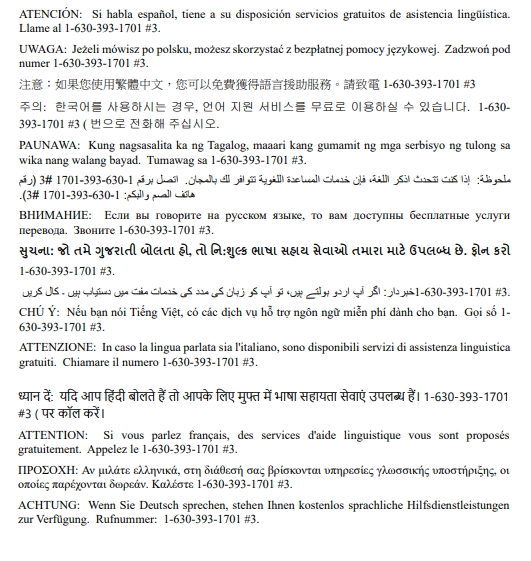
The IBEW Local 701 General Welfare Fund (the "Plan") complies with applicable Federal civil rights laws and does not discriminate on the basis of race, color, national origin, age, disability, or sex. The Plan does not exclude people or treat them differently because of race, color, national origin, age, disability or sex. The Plan provides language assistant services to persons whose primary language is not English, and free aids and services where necessary to people with disabilities to communicate effectively with us. If you need these services, contact the Fund Office.
If you believe that the Plan has failed to provide these services or discriminated in another way on the basis of race, color, national origin, age, disability, or sex, you can file a grievance by contacting the Fund Office by mail, telephone or in person at the IBEW Local 701 Welfare Fund, 28600 Bella Vista Parkway, Suite 1110, Warrenville, IL 60555, telephone 1-630-393-1701, #3. If you need help filing a grievance, Fund Office personnel are available to help you. You can also file a civil rights complaint with the U.S. Department of Health and Human Services, Office for Civil Rights electronically through the Office for Civil Rights Complaint Portal, available at https://ocrportal.hhs.gov/ocr/portal/lobby.jsf, or by mail or phone at: U.S. Department of Health and Human Services, 200 Independence Avenue SW., Room 509F, HHH Building, Washington, DC 20201, 1-800-868-1019, 800-537-7697 (TDD).
Complaint forms are available at http://www.hhs.gov/ocr/office/file/index.html.